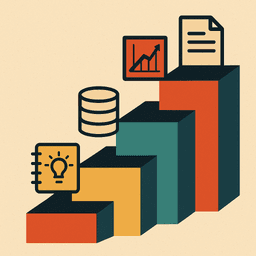
The Research Life Cycle
Dr. Nadim Mahmud
Foundational Research CurriculumLast updated: April 8, 2026
Introduction
The research process can feel overwhelming at first, but breaking it into distinct phases makes it easier to navigate. This guide outlines the core steps in a typical research project, from formulating a question to disseminating your results. Each phase includes tips, links to deeper resources, and common pitfalls to avoid.
While the diagram below shows nine sequential steps, research rarely proceeds in a straight line. You may refine your question after reviewing the literature, revise your study design after consulting a biostatistician, or rewrite your abstract three times before it is accepted. That is not failure: it is the process. Understanding the full life cycle will help you plan strategically, stay organized, and move your project forward with greater clarity.
The Life Cycle at a Glance
Hover any step to preview it. Click to jump to the detailed section below.
Hover any step to preview it, or scroll down for the full guide.
Process Overview
1. Generate a Research Question
Every research project starts with curiosity: a clinical observation, a pattern you have noticed, or a frustration in care delivery. Start by writing down what sparks your interest. Frameworks like FINER (Feasible, Interesting, Novel, Ethical, Relevant) or PICOT (Population, Intervention, Comparison, Outcome, Time) can help you turn an idea into a focused research question. A good research mentor can help you refine your question, align it with feasible methods, and connect it to meaningful outcomes.
Related resources:
2. Conduct a Literature Review
A strong research project depends on a solid understanding of prior work. Conducting a literature review helps you identify what is already known, where the knowledge gaps are, and how your question fits into the field. Begin by searching databases like PubMed, Google Scholar, and LitSense using relevant keywords and MeSH terms. Citation managers such as Zotero or EndNote can help you organize your findings efficiently. You can also use AI tools to summarize abstracts or recommend related articles, though it is important to critically review the outputs.
Related resources:
3. Choose a Study Design
Once you have solidified your research question and reviewed the literature, the next step is selecting a study design that aligns with your goals, timeline, and available resources. Will your project be observational, focused on analyzing real-world patterns and outcomes? Or will it be experimental, such as a randomized trial designed to test an intervention? A mentor can help you identify a methodologically sound and feasible approach. Thoughtful study design will strengthen your methods, simplify approvals, and guide the rest of your study.
Related resources:
4. IRB and Regulatory Review
Before beginning any research involving human participants or their data, review your institution's IRB requirements to determine the appropriate level of review. Some projects may qualify as exempt or fall under quality improvement (QI), which follow different pathways than standard IRB submissions. Understanding these distinctions early will help you plan your timeline and avoid delays. Even for minimal-risk studies, allow time for submission, review, and possible revisions. Most institutions also require research ethics training certifications before you begin.
Related resources:
5. Collect and Organize Data
Whether collecting new data or working with an existing dataset, it is critical to ensure your data are organized, standardized, and well-documented. For prospective studies, use consistent forms and follow a defined protocol. For retrospective projects, datasets often need to be curated, cleaned, and structured before analysis. A data dictionary should be developed early to define variables and prevent ambiguity. Even if you are not leading data management directly, understanding these processes will help you contribute to high-quality, reproducible research.
6. Analyze the Data
Data analysis should be guided by your study design, research question, and outcome measures. Many projects benefit from early collaboration with a biostatistician, who can help you select appropriate methods and anticipate challenges. While you may or may not perform the analysis yourself, it is important to understand the basic principles so you can interpret results and describe them accurately. Focus on matching methods to the data structure and keeping the analysis as simple as possible to start. AI tools can assist with writing analysis code, though all outputs should be independently verified.
Related resources:
7. Write Abstract and Manuscript
Writing is an essential part of the research process, not just a final step, but a way to clarify your thinking and communicate your findings. Most scientific papers follow the IMRAD format: Introduction, Methods, Results, and Discussion. A practical approach is to begin with a conference abstract, which helps you distill your key points and receive early feedback. From there, you can expand your work into a full manuscript. Focus on clear writing, logical flow, and appropriate framing of your conclusions. Feedback and revision are part of the process, even for experienced writers.
Related resources:
8. Submit, Revise, and Publish
Submission is a milestone, not a conclusion. Most manuscripts undergo at least one round of revision, and rejection is a common and often valuable part of the process. Take reviewer feedback seriously, respond thoughtfully, and use each submission as a learning opportunity. When selecting a journal, consider the scope, audience, and format that best fit your work. Aim for clarity, not perfection. Successful publication often depends as much on persistence as it does on polish.
Related resources:
9. Present and Disseminate Your Work
Sharing your findings through presentations is an essential part of the research process. Whether at a local symposium or a national meeting, posters and oral presentations allow you to communicate your results, gain feedback, and connect with other scholars. Dissemination is not just about visibility: it is how your work begins to inform practice, policy, or future research. Your first conference can also be a formative professional experience. Plan your schedule thoughtfully, engage actively in sessions, and use the opportunity to meet colleagues in your field.
Related resources:
Common Pitfalls to Avoid
- Choosing a vague or overly ambitious project: Broad questions are hard to execute. Start with something specific, focused, and feasible given your time and resources.
- Skipping the literature review: Without understanding prior work, you risk duplicating existing studies or missing important context that changes your question entirely.
- Delaying your IRB submission: IRB review often takes weeks to months. Starting the process late can push back your entire project. Submit as soon as your design is stable.
- Not involving a biostatistician early: Waiting until after data collection to plan your analysis can lead to missed opportunities, insufficient sample size, or design flaws that cannot be corrected later.
- Collecting data without a clear analysis plan: Know in advance how each variable will be used. Otherwise, your data may not support your question, or you may collect far more than you need.
- Underestimating the time needed to write and revise: Writing strong abstracts and manuscripts requires multiple drafts, feedback cycles, and time. Budget for it from the beginning.
- Treating dissemination as optional: Completing a study and not presenting or publishing it means the work does not contribute to the field. Dissemination is a professional responsibility, not a bonus.
Conclusion
No research project follows a perfectly linear path, and that is expected. The steps outlined above offer a practical framework to help you approach each phase with more clarity and structure. Whether you are refining a question, preparing an IRB submission, or writing a manuscript, each stage builds your skills and contributes to your development as a scholarly physician.
Research progress is often gradual and shaped by iteration. Take time to revisit your work, incorporate feedback, and adjust your approach as needed. This curriculum is here to guide you through each stage of that process.